
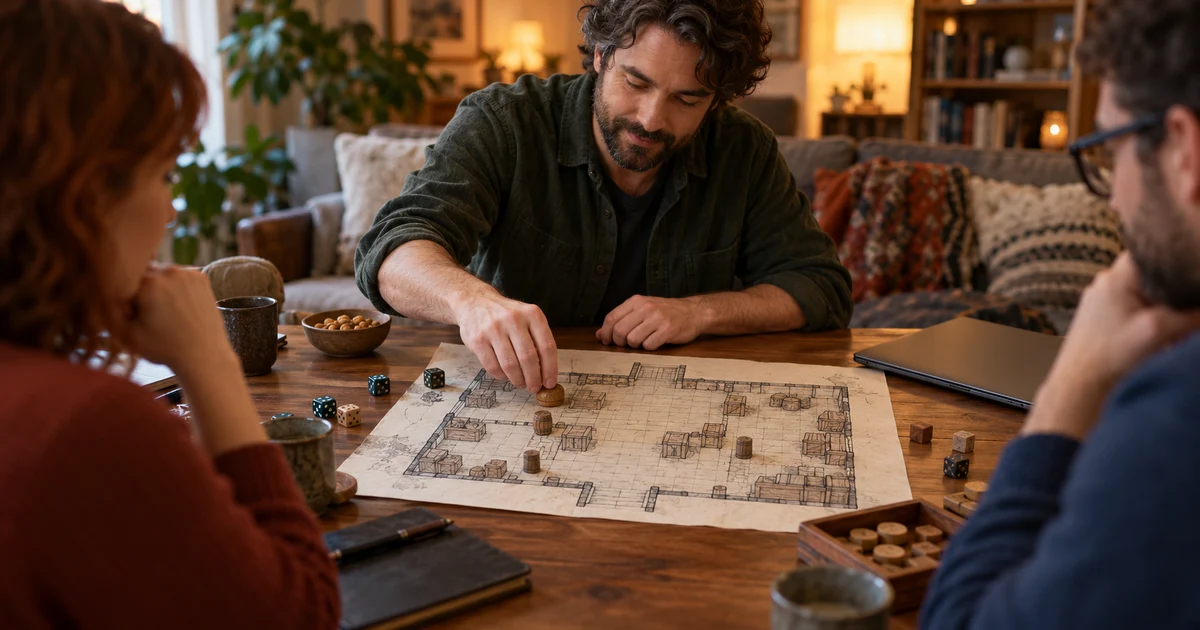
Prepare what is in the place and what the group can discover, while leaving their way in open. Try writing two entrances to the same warehouse and keeping its contents unchanged when the characters choose a different approach from the one you expected. You have a playable situation without requiring a fixed sequence of actions.
The warehouse and its characters are an original narrative suggestion. They are not an adventure included with DMGrid or new software features. Your table decides how to resolve attempts using its chosen game system.
The warehouse of unmarked crates
The example has a simple premise: the group seeks a crate that left the market without its usual seal. The warehouse stands beside a river. It has a street entrance and a loading entrance from the dock. Inside, one crate bears a different seal from the others.
The game master decides those facts before play. They do not write “the characters will trick the guard” or “they find the crate on their second attempt.” That would turn a possibility into an action nobody has chosen yet.
Two approaches, different information
| Prepared entrance | What you can describe on arrival | Open question |
|---|---|---|
| Street | A watcher recognizes the market carts | Will they talk, wait or find another approach? |
| Dock | Fresh drag marks lead towards the warehouse | Will they examine them or try entering there? |
The watcher and marks are invented facts of this scene, not general guarding or tracking rules. We set no difficulties, rolls, combat or automatic success. If players suggest the roof, resolve that new possibility using your table’s criteria; you do not need to pretend they chose one of your two entrances.
Keep three preparation layers
Separate what exists, what someone knows and what remains to be decided at the table. Here, the different crate exists; the watcher knows the cart schedule, but in our preparation does not know what the crate contains; how to investigate it remains open.
If the group talks to the watcher, do not automatically reveal the crate’s contents merely to steer them towards your planned ending. If they examine the dock, keep the same warehouse. Choices can change how information arrives without requiring you to change facts to enforce a route.
Where DMGrid fits
The official DMGrid facts document a world map with markers and location details, a campaign archive and sessions with formatted notes. Use that support to keep the warehouse description and preparation notes. This article’s three sections are a manual text organization, not new fields or a scene generator.
After play, record what actually happened. If nobody opened the crate, do not list its contents as a group discovery. The guide to picking up clues later covers that later review; here we prepared possibilities before the choice.
Examine methods without transferring their features
LegendKeeper publishes a preparation method with reference material and session notes. Obsidian Portal presents a wiki and adventure log. They offer other ways to organize campaigns, not evidence of web collaboration or their automation in DMGrid. Sources consulted on 23 October 2026.
Try the warehouse on paper and see whether you can answer an unexpected approach without writing the players’ actions. Check DMGrid if you want a local Windows 5E campaign manager. It is a paid beta with a perpetual one-device license, rather than a browser multiplayer room. Its direct installer link is for licensed customers, not a free demo.