
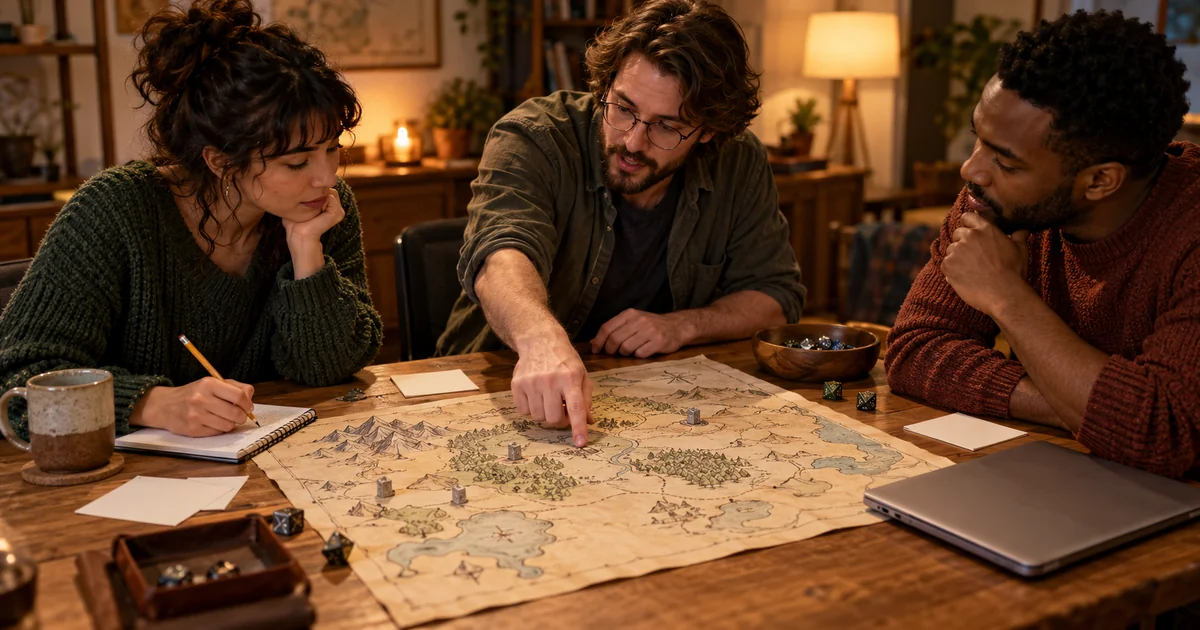
“Investigate the mill” does not say what the group discovered. A useful return-to-campaign note separates the place, the observed event and the open question. For example: “Ford Mill; we found a key marked with a wheat ear; we still do not know what it opens.” This is invented adventure material, not content bundled with DMGrid.
The difference is what you can retrieve before the next session. You do not need a novel; you need to distinguish what happened from what the characters suspect.
Record the event before its interpretation
In this example, finding the key happened in play. Thinking it opens the miller’s storehouse is a hypothesis. If you record only that hypothesis, you may later forget whether the group confirmed it or someone suggested it in passing.
A session note might contain:
- Place: Ford Mill.
- Event in play: the party collected a key engraved with a wheat ear.
- Hypothesis: it might belong to the storehouse.
- Open question: ask someone familiar with the mill.
The names and engraving are original to this example. They establish no D&D rule and require no particular roll; resolve the investigation under your table’s rules and decisions.
Return to the clue without inventing what happened between sessions
This timeline is original material for a sample adventure. You can play the next decision using paper, dice and your table’s rules; DMGrid is used here to keep the notes.
| Fictional moment | Fact recorded | Open question |
|---|---|---|
| Mill session | The party finds the key with the wheat mark | Which lock it opens |
| Following session | The party pursues another matter | The key has not been tried |
| Return to the mill | The party wants to investigate the storehouse | Whether to try the key or ask someone first |
Prepare two reference texts on paper or in your campaign notes. For the location: “Ford Mill: storehouse; possible connection with the key, unconfirmed.” For the discovery session: “We collected the key and proposed trying it; we did not do so.” The location detail and the played event serve distinct purposes.
The next decision belongs to your group: try the key or find someone at the mill. As the GM, decide from your adventure what information each route can reveal and which rules apply. This table is our written proposal, not automatic states or content included in DMGrid.
Keep location and session context
DMGrid combines a campaign archive, world map, locations and session notes on Windows. You can create places, edit map markers and inspect their details; sessions support formatted notes and preview.
To keep the example, first prepare the clue text in your session notes. Use the marker and location details to recognize the mill on the map. The public facts document those components but do not describe a specific clue editor within each place. If you repeat a name in both places to recognize it, that is your written convention. This guide does not claim an automatic link or a global clue-search feature.
Check three things before playing again
Before returning to the scene, prepare a recap for the group: “You found a key marked with an ear of wheat at the mill. You have not tested what it opens.” Do not add “it is the storeroom key” if that is only a hypothesis in your notes.
In your private preparation, keep two options for the next decision: try the key or ask about its mark. Decide which answers fit your adventure and which rules to use; we do not prescribe a lock, difficulty or mandatory revelation here.
After playing, update the note to match events. If the group tries the key and it does not open that door, the result settles that door’s question; it does not establish that the key is useless everywhere. If they leave without testing it, the question remains open. These are branches of the invented example, not outcomes generated by DMGrid.
If you will show material on a player display, review what will be visible before sharing it. The group recap and your private options serve different purposes.
Other tools organize worlds and histories too
LegendKeeper documents maps and world context. Obsidian Portal presents a wiki and adventure log. These are established approaches; we have not measured which retrieves a clue fastest.
This example fits DMGrid’s published components as a local Windows campaign manager. It implies no online rooms, coediting or AI-generated adventures. Sources checked on October 23, 2026.
Check the fit for your table
DMGrid is paid beta software for one Windows device, with campaigns saved on the computer. Review recorded application walkthroughs and current conditions before buying; the customer installer is not a free demo. Check scope and limits in the product facts.