
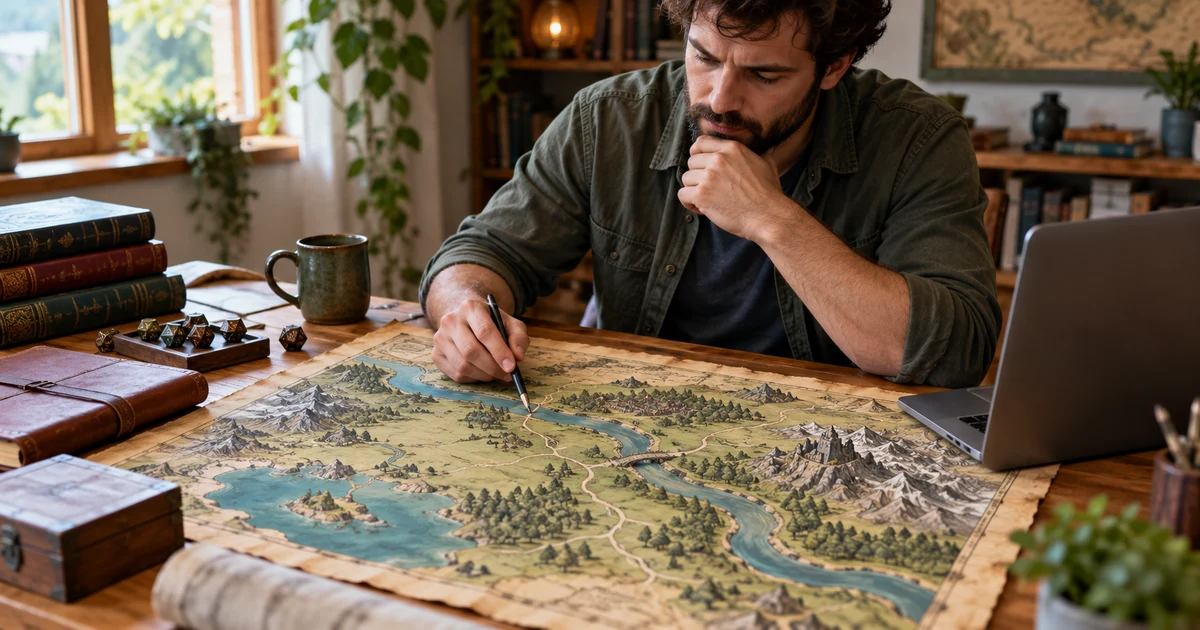
Two markers still leave the route undecided
Two villages looking close on a world map does not establish a usable route or how long the journey takes. Before announcing that the party will arrive that afternoon, prepare which paths exist, what the characters know and which decision remains open.
The DMGrid product facts document a world map with editable markers, location details, and campaign and session notes. You can organise preparation there. They do not attribute automatic route, weather or journey-time calculations to DMGrid.
A closed bridge and two prepared paths
Imagine two fictional villages, Olmeda and Valclaro, separated by a river. The drawn road crosses a bridge, but you have prepared that the bridge is closed. Nearby markers do not remove that scenario condition.
Prepare two alternatives without deciding for your players:
| Invented route | What you established as GM | What remains to decide or check |
|---|---|---|
| Bridge road | The crossing is closed in this scene | What the group learns and what they attempt there |
| Path to another crossing | A longer detour exists in your preparation | Whether the group knows it and chooses it |
We do not add kilometres or hours just to fill the table. If your adventure establishes distances, note the source and apply your table’s agreed rules. If they are undefined, resolve that preparation before presenting an arrival time as certain.
Separate the place from its connecting path
Location details can hold facts about the destination: who is waiting or what remains unresolved there. In a preparation note, distinguish the bridge’s state from alternatives you actually defined. A destination description should not accidentally become evidence that the road is open.
Also identify what the characters know. The bridge being closed may be true in your preparation without the party knowing it yet. When preparing notes to share, check what the group should know before showing them; a private GM note does not become public just because it relates to a location.
These are manual preparation decisions, not instructions for a specific publishing control or a character-knowledge engine.
Timing follows the conditions
Once the party chooses a route, review distance, travel method and conditions under your campaign’s rules. Do not translate a tactical movement radius directly into travel hours between settlements. This guide defines no universal speed and does not simulate a journey in the app.
DMGrid is a Windows beta for in-person 5E campaigns saved on the computer. Its current scope does not include online rooms or browser multiplayer. The product presentation explains its tools and purchase; the installer is for licensed customers, not a free demo.
For the next session, prepare destination, route and unresolved question as recognisable parts. The party can choose afterwards: your map helps locate the decision, but nearby markers do not make it for them.